
Pune vs Bangalore Weather: Climate Comparison
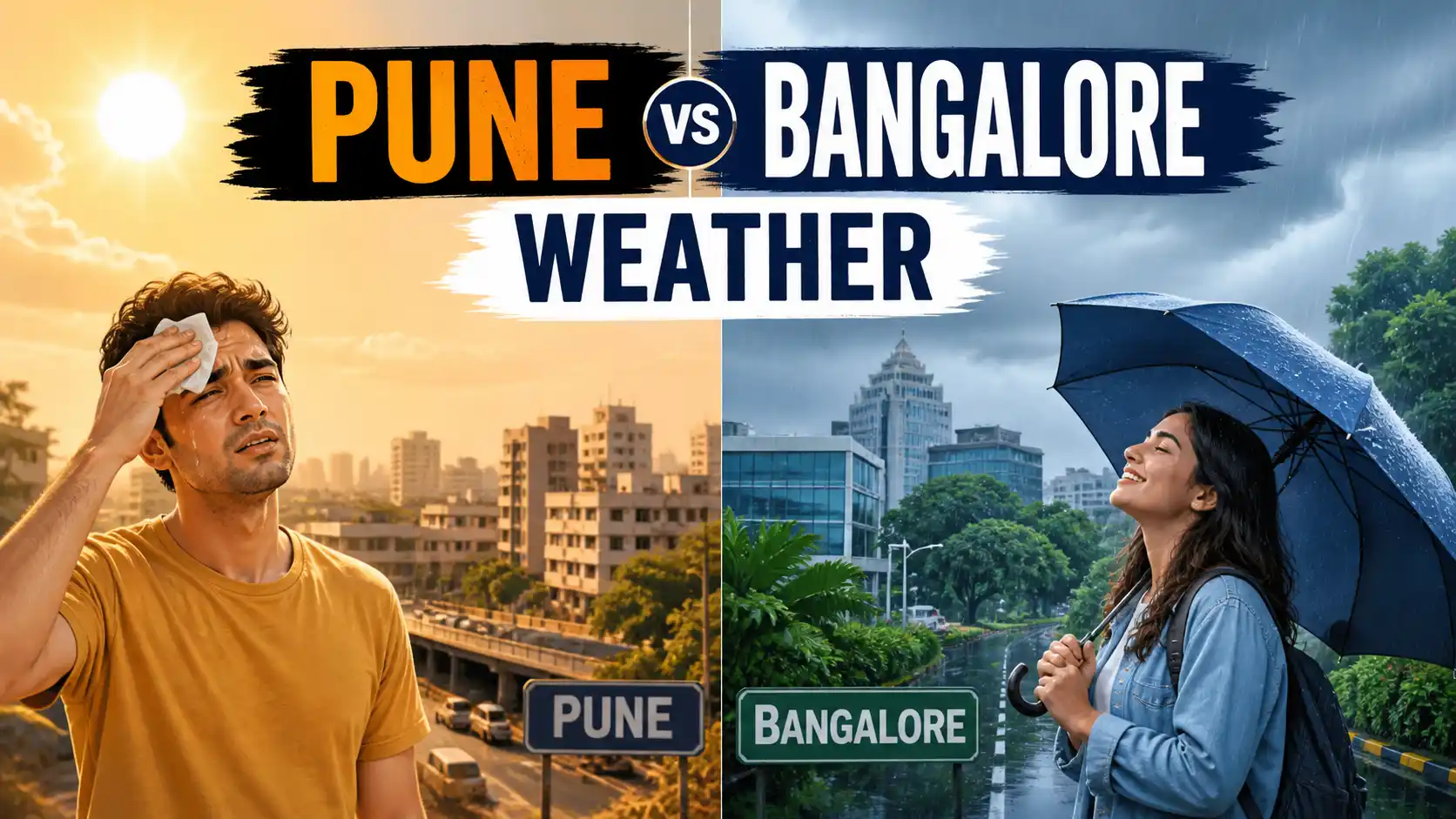
It's not a trivial concern. Whether you're a software engineer deciding between an offer in Whitefield or Hinjewadi, a family planning relocation, or just a traveler planning your next trip — the climate of a city shapes daily life more than most people expect. It affects how you sleep, how much energy you have on your commute, and yes, even how productive you feel.
Here's what most people don't realize: both Pune and Bangalore have a tropical savanna climate on paper. But their lived experience is worlds apart. One city swings between scorching summers and sharp winters. The other stays unnervingly pleasant for most of the year. Let's break it all down — honestly.
Bangalore has milder, more consistent weather year-round — rarely too hot, rarely too cold.
Pune experiences harsher summers (38–42°C) but arguably the best winters in any Indian metro (10–15°C nights, dry and clear).
For overall comfort across 12 months, Bangalore leads. For peak-season liveability (Nov–Feb), Pune competes strongly.
Quick Comparison: Pune vs Bangalore Weather at a Glance
Before going
deep, here's a side-by-side snapshot. Notice the difference in summer
temperatures — that single factor reshapes everything from your electricity
bills to your outdoor lifestyle.
|
Feature |
Pune |
Bangalore |
Edge |
|
Peak Summer Temp |
38–42°C |
28–33°C |
Bangalore ✓ |
|
Winter Low |
10–15°C |
15–20°C |
Bangalore ✓ |
|
Annual Rainfall |
~700 mm |
~970 mm |
Pune (drier) |
|
Monsoon Duration |
~3 months |
~5–6 months |
Pune ✓ |
|
Avg Humidity (Jul) |
65–75% |
78–88% |
Pune ✓ |
|
Year-round Comfort |
Moderate |
High |
Bangalore ✓ |
|
Best Months |
Nov–Feb |
Sep–Feb |
Tie |
Bangalore sits
at roughly 920 metres above sea level. Pune is at about 560 metres. That
360-metre difference is the single biggest reason for Bangalore's cooler
climate — and it's why the city earned the nickname 'Air-Conditioned City of
India.' Altitude matters more than most climate comparisons acknowledge.
Pune Weather Overview
Pune's climate
sits in an interesting middle ground — semi-arid, but touched by the monsoon.
You can explore detailed historical weather patterns for Pune at WeatherBlaze's Pune Weather History, which shows month-by-month data going back decades.
The city lies
in the rain shadow of the Western Ghats, which is why it receives far less
rainfall than the Konkan coast just a few hours west. The result is a city that
can be brutally hot in summer, pleasantly cool in winter, and genuinely
enjoyable during the post-monsoon months.
Summer in Pune (March–June)
This is where
Pune shows its fierce side. March starts mild, but by April and May,
temperatures routinely cross 38–40°C. In some years — particularly during El
Niño phases — heatwaves push the mercury close to 43°C. The India
Meteorological Department (IMD) has been issuing more frequent heatwave
advisories for Pune over the past decade, reflecting a genuine shift in summer
severity.
The air is dry, not the sticky humid heat of Mumbai — but the intensity is real. Afternoons become genuinely difficult from April through June. Expect electricity bills to spike, water consumption to rise, and outdoor activity to essentially pause until evening
Monsoon in Pune (July–September)
Relief arrives
with the southwest monsoon, typically around June 10–15. Pune receives about
700 mm of rainfall annually — concentrated between July and September.
Temperatures drop into the pleasant 22–28°C range, and the city turns
remarkably green.
But here's a
catch that surprises many newcomers: the Western Ghats absorb the bulk of
monsoon moisture before it reaches Pune. So while there are genuinely rainy
days, they're regularly interspersed with sunny spells. The monsoon in Pune is
enjoyable in a way that monsoons in coastal cities are not.
Winter in Pune (November–February)
This is Pune's
golden season — and arguably the finest urban winter experience anywhere in
Peninsular India. Night temperatures drop to 10–15°C (touching 8°C on the
coldest January nights). Days stay comfortable in the mid-to-upper 20s. The sky
is clear, the air is dry, and the city is at its most liveable.
Locals love it.
Weekend mornings for cycling, afternoon chai on open terraces, evenings at
Sinhagad or along the Mula-Mutha riverfront. If you only visit Pune once, make
it between November and February.
Bangalore Weather Overview
Bangalore's
climate is often described as 'perpetual spring' — and that reputation is
largely earned. You can verify actual historical weather patterns for Bangalore
at WeatherBlaze's Bangalore Weather History, where the data tells a story of remarkable consistency.
Unlike Pune,
Bangalore doesn't experience dramatic seasonal swings. There's no brutal
summer. Winters are mild rather than sharp. This stability is the core appeal —
and according to the World Meteorological Organization (WMO), cities at
elevations above 900 metres in tropical latitudes tend to experience exactly
this kind of 'climate buffering.'
The trade-off?
More rain, and a rainy season that stretches far longer than most people
anticipate.
Summer in Bangalore (March–May)
Even at its
hottest — April and early May — Bangalore temperatures typically max out at
33–35°C. That's warm, but workable. The pre-monsoon showers (called 'mango
showers' or Kalbaishakhi locally) that arrive in May act like natural air
conditioning, breaking the heat with sudden afternoon storms.
This is where
things get interesting: compare Bangalore's 33°C summer to Pune's 42°C, and
you're looking at a nearly 10-degree difference. For anyone heat-sensitive,
that gap is life-changing — not just uncomfortable, but genuinely
health-relevant.
Monsoon in Bangalore (June–October)
Here's the part
Bangalore's fans don't always mention. The city receives rain from both the
southwest and northeast monsoons — which means its rainy season runs from June
all the way through November. Annual rainfall averages around 970 mm,
considerably more than Pune.
October and September are particularly intense. NOAA's climate pattern analysis shows that the Bay of Bengal low-pressure systems that fuel the northeast monsoon have been intensifying in recent years, making October in Bangalore progressively wetter. Flooding in low-lying areas is a real and recurring problem. The city's drainage infrastructure, despite continued investment, still struggles during peak events.
Winter in Bangalore (November–February)
Gentle rather
than sharp. Night temperatures settle around 15–17°C — comfortable, but lacking
the crisp bite of a Pune January. Foggy mornings are common in December,
especially in peripheral tech corridors like Electronic City and Whitefield.
It's pleasant,
unhurried, and ideal for outdoor dining. But if you're from North India and
craving a 'real winter,' Bangalore's mild cold might feel anticlimactic.
Monthly Weather Comparison: Pune vs Bangalore
Here's the full
picture — every month of the year, side by side. These patterns are based on
historical IMD data and long-term climate averages.
|
Month |
Pune Temp |
Blr Temp |
Pune Rain |
Blr Rain |
Comfort Edge |
|
Jan |
10–28°C |
15–27°C |
~3 mm |
~5 mm |
Tie |
|
Feb |
12–32°C |
16–30°C |
~1 mm |
~8 mm |
Tie |
|
Mar |
17–36°C |
19–33°C |
~5 mm |
~15 mm |
Bangalore |
|
Apr |
22–39°C |
21–34°C |
~18 mm |
~38 mm |
Bangalore |
|
May |
23–38°C |
21–33°C |
~30 mm |
~108 mm |
Tie |
|
Jun |
22–30°C |
20–28°C |
~100 mm |
~78 mm |
Bangalore |
|
Jul |
22–28°C |
19–26°C |
~135 mm |
~109 mm |
Bangalore |
|
Aug |
21–28°C |
20–27°C |
~115 mm |
~130 mm |
Tie |
|
Sep |
21–30°C |
20–28°C |
~100 mm |
~195 mm |
Pune |
|
Oct |
20–32°C |
20–28°C |
~65 mm |
~172 mm |
Pune |
|
Nov |
14–30°C |
16–26°C |
~25 mm |
~62 mm |
Tie |
|
Dec |
11–28°C |
15–25°C |
~5 mm |
~20 mm |
Tie |
Notice the pattern: Bangalore leads in comfort for most months. But September through October — when Bangalore is at its rainiest — Pune is actually more pleasant. And January to February? Both cities are genuinely outstanding, just in different ways.
Rainfall Comparison: Which City Gets More Rain?
Short answer:
Bangalore gets more rain, for longer, and increasingly with more extreme
events. Here's the detail.
Pune's
Monsoon: Pune receives roughly 650–750
mm annually. The southwest monsoon arrives around June 10–15 and wraps up by
mid-September — about 3 months of significant rain, concentrated and then done.
The rain shadow effect keeps Pune noticeably drier than comparable cities at
similar latitudes.
Bangalore's
Monsoon: Bangalore averages 950–1,000 mm
per year, stretched across a much longer window. The southwest monsoon delivers
heavy rain from June to August. Then the northeast monsoon takes over in
October–November — something Pune barely experiences. That's effectively two
rainy seasons.
What does that mean in practice? In Bangalore, you need a rain jacket for roughly 5–6 months of the year. In Pune, it's closer to 3. But here's the thing — Bangalore's rain often comes in sudden, violent bursts rather than prolonged drizzle. Commuters deal with flash flooding, waterlogged roads, and the city's infamous traffic compounded by monsoon chaos.
For those who love the monsoon atmosphere — petrichor, chai with pakoras, evenings watching sheets of rain — Bangalore offers more of it. For those who find rain disruptive, Pune's shorter, cleaner monsoon window is often preferred.
Temperature Comparison: Which City Is Hotter?
Pune is hotter.
Significantly. There's no nuance needed here.
Peak Summer:
Pune regularly hits 38–42°C in
April–May. On some days, with the heat index factored in, it feels even higher.
Bangalore peaks at 33–35°C — a difference of up to 10 degrees. That's not a
minor variation. That's the difference between stepping outside and not wanting
to.
Temperature
Stability: Bangalore's annual
temperature range spans roughly 10–12°C between its coldest and hottest months.
Pune's range can stretch to 20–25°C. This stability is what makes Bangalore
consistently liveable — your body doesn't need to constantly recalibrate.
Heatwaves: Pune experiences genuine heatwave conditions —
IMD-classified events where temperatures exceed 40°C for multiple consecutive
days. Bangalore, with its elevation and frequent pre-monsoon showers, rarely
sees true heatwave conditions. When it does, they're shorter and milder.
This is where
Pune's climate draws a sharp line. If you have cardiovascular conditions, are
pregnant, elderly, or simply struggle in the heat, the summer months in Pune
(April–June) can be more than uncomfortable — they can be genuinely harmful.
Bangalore's summer is, for most people, completely manageable without special
precautions.
Key Weather Trends: 1981–2025
Here's what
most people don't realize when comparing these two cities: the climate you're
moving to isn't the climate that was here 20 years ago. Both Pune and Bangalore
have experienced measurable shifts over the past four decades.
According to
long-term data tracked by the India Meteorological Department and
cross-referenced with global datasets maintained by NOAA, here are the most
significant trends:
|
Indicator |
Pune (Trend) |
Bangalore (Trend) |
|
Summer max temp |
+1.2°C since 1981 |
+0.9°C since 1981 |
|
Annual rainfall variability |
±15–20% |
±20–25% |
|
Monsoon onset (avg) |
June 10–15 |
June 5–10 |
|
Heatwave frequency |
Increasing (Apr–Jun) |
Rare; slight increase |
|
Winter low (avg) |
Warming by ~0.6°C |
Warming by ~0.5°C |
|
Extreme rain events |
Moderate increase |
Significant increase |
Pune's summers
are getting longer and more intense. Heatwave advisories that were rare in the
1990s now arrive almost every year in April and May. If you're making a 10-year
relocation decision, this trend matters.
Bangalore's
shift is subtler but still relevant. Rainfall variability has increased —
meaning the city swings between drought-like spells and sudden extreme rain
events more sharply than before. The 2022 floods were partly a product of this
pattern. The World Meteorological Organization's regional climate assessments
for South Asia point to intensifying monsoon extremes as a long-term trend for
both cities.
The takeaway: Bangalore's climate advantage over Pune is real today — and the gap may widen further as temperatures rise. That's worth factoring into any long-term decision about where to live.
Which City Has Better Weather? The Honest Answer
Honestly? It
depends on who you're asking — but the data leans one way.
If you surveyed
people who've lived in both cities, the majority would likely say Bangalore's
weather is more consistently comfortable. And climatologically, that's accurate
— milder summers and stable temperatures matter enormously to daily quality of
life.
But 'better
weather' is personal. Here's how it breaks down:
For IT Professionals
Bangalore wins.
Long desk hours and evening commutes are more manageable when the ambient
temperature hovers between 20–28°C rather than 35–42°C. That said, monsoon
flooding can add hours to Bangalore commutes in October — something worth
planning around.
Pune's weather
in Hinjewadi and Kharadi is perfectly workable for 7–8 months of the year. The
IT infrastructure has matured to the point where city comparisons are less
about weather and more about role fit. But if weather is your tiebreaker,
Bangalore takes it.
For Families with Children
Bangalore
again. Children can be outdoors more months of the year, school schedules
aren't disrupted by extreme heat warnings, and the physical environment is
gentler on young bodies. Pune's April–June heat can genuinely affect children's
health and comfort.
For Retirees
This one's a
closer call. Pune wins on drier air — lower humidity year-round is better for
joint health and respiratory conditions. Bangalore wins on temperature comfort.
If you have asthma or similar issues, Bangalore's monsoon humidity (85%+) can
be problematic. Many retirees with respiratory sensitivity actually prefer
Pune's drier climate, particularly in winter.
Best Time to Visit Pune vs Bangalore
Best Time to Visit Pune
October to
February is the sweet spot for weather in Pune.
Post-monsoon Pune (October–November) is lush, clean, and pleasantly warm.
December and January are ideal for sightseeing — Sinhagad Fort, Lonavala,
Mahabaleshwar are all at their best during this window. February is still
excellent before the summer heat begins to build.
Avoid
April–June unless you have business commitments. The heat during this stretch
makes tourism uncomfortable and potentially draining.
Best Time to Visit Bangalore
September to
February offers the best experience for weather in Bangalore.
Post-monsoon October is particularly beautiful — parks are green, the air is
fresh, and temperatures are perfect for walking.
January and
February are ideal for Lalbagh's Flower Show, exploring Cubbon Park, and
café-hopping in Indiranagar. May and early June are also acceptable, with
pre-monsoon showers keeping the heat manageable. Avoid mid-August through
October if you dislike heavy, disruptive rain.
Key Takeaways
•
Bangalore's climate is more
stable — rarely exceeding 35°C or dropping below 14°C, making it comfortable
for most of the year.
•
Pune's summers (38–42°C,
April–June) are significantly harsher; its winters (10–15°C, Nov–Feb) are
significantly crisper and drier.
•
Bangalore receives roughly
40% more annual rainfall (~970 mm vs ~700 mm) and has a longer monsoon season
due to two monsoon systems.
•
Pune's shorter monsoon
(June–September) is less disruptive in terms of flooding, commute impact, and
infrastructure strain.
•
Long-term trends show both
cities warming, with Pune's summer intensification more acute — a growing
concern for long-term residents.
•
For IT professionals,
families, and general liveability, Bangalore holds a clear weather advantage.
•
For those who value dry
air, crisp winters, and a shorter rainy season, Pune has genuine appeal —
especially from November through February.
• Altitude is the key variable: Bangalore's ~920m elevation versus Pune's ~560m explains most of the climate difference.
Is Pune hotter than Bangalore?
Which city has better weather — Pune or Bangalore?
Does Bangalore have better weather than Pune?
Which city has more rainfall — Pune or Bangalore?
Is Pune weather comfortable year-round?
Which city is better for people sensitive to humidity?
How are long-term climate trends affecting both cities?
Sources and Methodology
- Climate normals and temperature/rainfall ranges are based on India Meteorological Department (IMD) historical records, long-term averages from WeatherBlaze's Pune and Bangalore weather history archives, and seasonal pattern data consistent with WMO climate normal periods
- Date checked: All data reviewed and verified in May 2025.
- All temperature and rainfall figures represent long-term averages and may vary by microclimate, locality, and year. Urban heat island effects can push temperatures 1–2°C higher in densely built areas within both cities. Monsoon onset and withdrawal dates shift year to year by 1–2 weeks. Readers should treat ranges as indicative rather than precise forecasts.
Explore
Historical Weather Data:
WeatherBlaze — Bangalore Weather History
| WeatherBlaze — Pune Weather History